
Uncategorized
UniFi U6+ vs U6 Pro: Which Is Right for You?
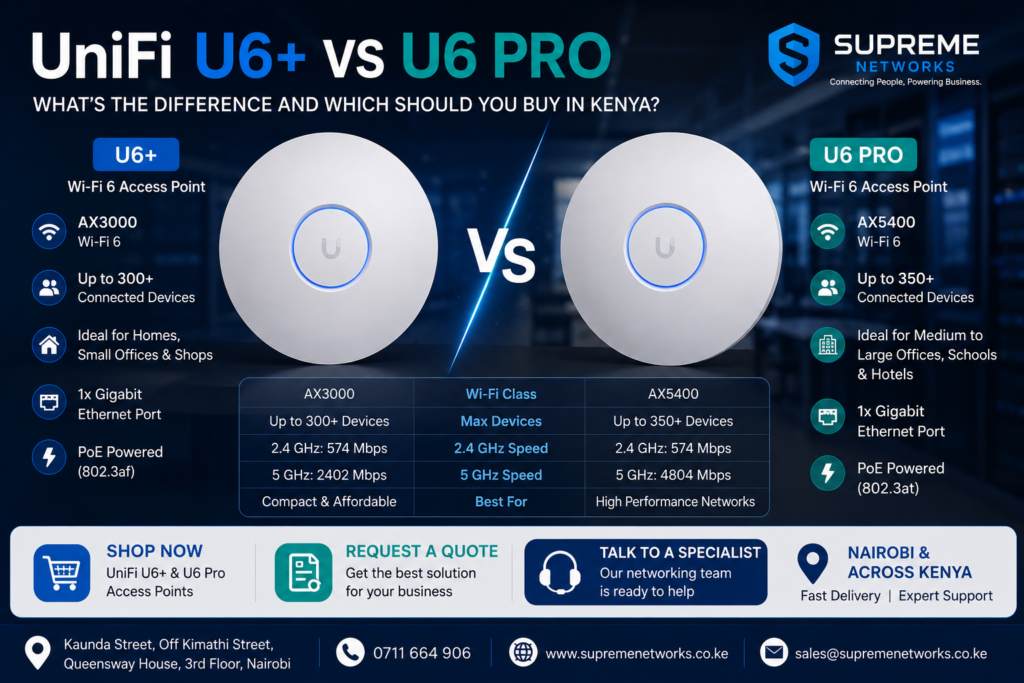
Choosing between the UniFi U6+ vs U6 Pro in Kenya depends on the size of your network, number of users, wireless demand, and budget. Both are Wi-Fi 6 access points, but they are designed for different network requirements. The UniFi U6+ is a practical choice for homes, small offices, shops, and normal business Wi-Fi, while the UniFi U6 Pro is better suited to busier offices, schools, hotels, restaurants, conference areas, and networks with more simultaneous users. Supreme Networks supplies the UniFi U6+ and U6 Pro in Nairobi and across Kenya. Shop online, request a quote, or contact our networking team if you need help choosing the right access point.
Looking for a UniFi Wi-Fi 6 Access Point?
→ Shop UniFi U6+
→ Shop UniFi U6 Pro
→ Request a Quote
→ Talk to a Networking Specialist
If both access points use Wi-Fi 6, why should you pay more for a U6 Pro?
The answer is not simply speed.
The best choice depends on where the access point will be installed, how many people will use it, and how demanding the wireless network will become.
This comparison will help you choose the right solution.
UniFi U6+ vs U6 Pro: Quick Comparison
| Feature | UniFi U6+ | UniFi U6 Pro |
|---|---|---|
| Wi-Fi Generation | Wi-Fi 6 | Wi-Fi 6 |
| Wi-Fi Class | AX3000 | AX5400 |
| 2.4 GHz | Wi-Fi 6 | Wi-Fi 6 |
| 5 GHz | Wi-Fi 6 | Wi-Fi 6 |
| Ethernet | Gigabit Ethernet | Gigabit Ethernet |
| Power | PoE | PoE |
| Best For | Homes and small businesses | Busier professional networks |
| Typical Environment | Home, shop, small office | Office, school, hotel, restaurant |
| User Demand | Low to moderate | Moderate to high |
| Positioning | Value-focused | Performance-focused |
Both models provide modern Wi-Fi 6 connectivity. However, the U6 Pro offers greater wireless capability for more demanding environments.
What Is the UniFi U6+?
The UniFi U6+ is a compact Wi-Fi 6 access point designed to provide reliable wireless connectivity without unnecessarily increasing the cost of a network installation.
It is particularly useful where customers need modern Wi-Fi for normal daily applications.
These can include:
- Web browsing
- Cloud applications
- Video streaming
- Video meetings
- Social media
- Smartphones
- Tablets
- Laptops
- Smart TVs
For many small businesses, these are the applications that matter most.
Therefore, buying a higher-end access point may not always be necessary.
Where Does the UniFi U6+ Make Sense?
The U6+ can be a good choice for:
Small Offices
A small office with moderate wireless usage may not need a high-capacity AP.
Employees may mainly use laptops and smartphones for normal business activities.
In this situation, the U6+ provides a practical Wi-Fi 6 solution.
Homes
The U6+ can also provide reliable home Wi-Fi for:
- Streaming
- Smartphones
- Smart TVs
- Home offices
- Tablets
- General browsing
- Gaming
For larger homes, however, multiple access points may be more effective than one AP.
Shops and Retail Businesses
Retail environments often need Wi-Fi for staff devices, laptops, POS-related network equipment, phones, and customer connectivity.
The U6+ can provide a good foundation where wireless demand remains moderate.
Small Restaurants and Cafés
A smaller restaurant may use Wi-Fi for staff operations while also providing guest internet access.
Again, the number of simultaneous users should guide the final decision.
What Is the UniFi U6 Pro?
The UniFi U6 Pro is designed for more demanding Wi-Fi 6 deployments.
It provides greater wireless capability than the U6+ and is better suited to environments where many devices may communicate simultaneously.
This makes it attractive for professional and commercial networks.
Where Does the UniFi U6 Pro Make Sense?
Consider the U6 Pro for environments such as:
Medium and Large Offices
An office can quickly accumulate wireless devices.
For example, 40 employees could have:
- 40 laptops
- 40 smartphones
- Tablets
- Wireless printers
- Meeting-room equipment
- Smart displays
- Other network devices
Therefore, the number of devices can become much higher than the number of employees.
A U6 Pro may be a stronger choice for these environments.
Schools
Schools can have very high wireless density.
A single classroom may contain dozens of laptops, tablets, and smartphones.
Meanwhile, teachers and administrative staff may use additional devices.
The U6 Pro is therefore worth considering when designing Wi-Fi for classrooms and other busy educational areas.
Hotels
Hotels require reliable connectivity across different environments.
These can include:
- Guest rooms
- Reception areas
- Restaurants
- Conference rooms
- Lounges
- Business areas
A properly planned deployment may use several U6 Pro access points to provide consistent coverage and capacity.
Restaurants
Busy restaurants can have many customers connected simultaneously.
Staff may also rely on the same network infrastructure for business applications.
Therefore, a higher-capacity AP can make sense.
Conference Rooms
Conference rooms are a good example of why coverage alone is not enough.
The room may be relatively small, but dozens of users could connect at once.
This creates a capacity requirement rather than simply a range requirement.
U6+ vs U6 Pro: Which Is Faster?
The U6 Pro offers greater overall wireless capability.
However, customers should avoid choosing an access point based only on its maximum theoretical wireless rate.
Real-world performance depends on several factors, including:
- Client device
- Distance from the AP
- Wireless interference
- Channel width
- Number of connected devices
- Network configuration
- Ethernet connection
- Internet speed
Therefore, an AX5400 label does not mean every connected device will achieve that speed.
Does the U6 Pro Have Better Range?
This is one of the most common questions when comparing access points.
A higher-end access point may provide stronger performance in some environments, but range should not be the only reason to choose the U6 Pro.
Building construction has a major impact on Wi-Fi.
Signal can be reduced by:
- Concrete walls
- Floors
- Metal
- Glass
- Shelving
- Furniture
- Doors
- Other wireless networks
If your problem is poor coverage across a large property, installing another access point may provide better results than simply replacing a U6+ with a U6 Pro.
U6+ vs U6 Pro for Small Offices
For a small office, the U6+ will often be the more practical choice.
It can provide modern Wi-Fi 6 connectivity while keeping the overall project cost reasonable.
Consider the U6+ when:
- User numbers are relatively low.
- Wireless usage is moderate.
- The office is relatively small.
- Most applications are normal business applications.
- Budget matters.
However, consider the U6 Pro if the small office has unusually high wireless demand.
For example, a design studio transferring large files may have different requirements from an accounting office of the same size.
U6+ vs U6 Pro for Large Offices
For larger and busier offices, the U6 Pro generally becomes more attractive.
However, do not expect one U6 Pro to cover an entire large office.
A better network may use several access points.
For example:
Open Office → Access Point
Meeting Rooms → Access Point
Executive Offices → Access Point
This approach can provide better coverage and distribute users across several APs.
U6+ vs U6 Pro for Hotels
For hotels, the U6 Pro may be more appropriate in busy areas.
However, the correct design depends heavily on the building.
Hotel Wi-Fi must deal with:
- Multiple rooms
- Thick walls
- Several floors
- Corridors
- High guest numbers
Therefore, multiple correctly positioned access points are usually more important than simply selecting one powerful AP.
U6+ vs U6 Pro for Schools
For smaller administrative offices or low-density areas, a U6+ may be sufficient.
For classrooms and high-density areas, the U6 Pro may be more appropriate.
The network should be planned around both:
Coverage + Capacity
A strong Wi-Fi signal does not automatically mean the network can handle every connected device effectively.
U6+ vs U6 Pro for Home Wi-Fi
For most homes, the U6+ can provide an excellent balance between performance and cost.
It can support common household applications such as:
- Netflix and streaming
- Smartphones
- Laptops
- Smart TVs
- Home office applications
- Gaming
- Tablets
The U6 Pro may make sense for larger households with heavier wireless usage.
However, for a large or multi-storey home, multiple APs may still provide better coverage.
Do Both Access Points Need PoE?
Both the U6+ and U6 Pro are designed around Power over Ethernet deployment.
PoE allows an Ethernet connection to deliver both data and electrical power to the access point.
Your network may therefore require a compatible:
- PoE switch
- PoE injector
Always confirm the exact power requirements of the access point and the power capabilities of the switch or injector before installation.
Do You Need a UniFi Switch?
A UniFi switch can provide a more integrated UniFi environment, but your wider network design will determine the equipment required.
When choosing a switch, consider:
- Number of ports
- PoE support
- PoE power budget
- Uplink requirements
- Future expansion
If you plan to install several access points, ensure the switch can provide sufficient PoE power for all required devices.
What Network Cable Should You Use?
A professional Wi-Fi installation should use quality Ethernet cabling.
For many modern installations, Cat6 network cable provides a practical starting point.
The complete installation may also require:
- Cat6 cable
- Patch panel
- Patch cords
- Data cabinet
- Network modules
- Faceplates
- Cable management
Good Wi-Fi starts with good wired infrastructure.
Should You Buy U6+ or U6 Pro?
Here is the simplest way to decide.
Buy the UniFi U6+ If:
- You have a home or small office.
- Your wireless demand is moderate.
- You need reliable Wi-Fi 6.
- You want good value.
- You have relatively few simultaneous users.
- You need everyday business connectivity.
Buy the UniFi U6 Pro If:
- You have more users.
- Your network is busier.
- You are installing Wi-Fi in a medium or large office.
- You need Wi-Fi for a school.
- You need Wi-Fi for a hotel.
- You have busy conference rooms.
- You expect greater wireless demand.
The U6 Pro is not automatically better simply because it has higher specifications.
The correct choice is the model that matches your environment.
What If You’re Building a New Network?
There is another question worth asking:
Should you still buy Wi-Fi 6, or should you consider UniFi Wi-Fi 7?
The U6+ and U6 Pro remain useful Wi-Fi 6 options.
However, customers building a completely new network may also want to compare them with newer U7 models such as:
- UniFi U7 Lite
- UniFi U7 Pro
- UniFi U7-LR
Wi-Fi 7 may make sense where newer technology and future expansion are priorities.
Before buying, compare the cost of the complete network rather than only the access point.
Don’t Overspend on the Wrong Solution
Suppose you have a large office with poor Wi-Fi coverage.
Buying one U6 Pro instead of a U6+ may not solve the problem.
The real solution could be:
Multiple access points + correct placement + quality cabling + suitable PoE switching + proper configuration.
Likewise, a small office with ten users may not need the additional capability of a higher-end model.
A good network should solve the actual requirement without unnecessary equipment.
Buy UniFi U6+ and U6 Pro in Kenya
Supreme Networks supplies UniFi U6+ and U6 Pro access points in Nairobi and across Kenya for home, office, hospitality, education, retail, and commercial networks.
We can also help with supporting network equipment, including:
- UniFi switches
- PoE switches
- PoE injectors
- Routers and gateways
- Cat6 network cables
- Data cabinets
- Patch panels
- Patch cords
- Network accessories
- Structured cabling
- Wi-Fi installation
Need Help Choosing U6+ vs U6 Pro?
Tell us about your network before you buy.
Useful information includes:
- Number of users
- Number of devices
- Office or building size
- Number of floors
- Internet speed
- Existing router
- Existing switch
- Indoor or outdoor coverage requirements
- Current Wi-Fi problem
Our networking team can help identify a suitable solution based on your requirements.
Ready to Upgrade Your Wi-Fi?
→ Shop UniFi U6+
A practical Wi-Fi 6 solution for homes, small offices, shops, and everyday business networks.
→ Shop UniFi U6 Pro
A higher-performance Wi-Fi 6 option for offices, schools, hotels, restaurants, and busier networks.
→ Request a Quote
Get pricing for your access points and supporting network equipment.
→ Talk to a Networking Specialist
Not sure which model you need? Get help selecting the right UniFi solution.
Supreme Networks
Kaunda Street, Off Kimathi Street
Queensway House, 3rd Floor, Nairobi
Call: 0711 664 906
Serving customers in Nairobi and across Kenya.
Frequently Asked Questions
What is the difference between UniFi U6+ and U6 Pro?
Both are Wi-Fi 6 access points. The U6+ is positioned as a practical solution for homes and moderate business environments, while the U6 Pro offers greater wireless capability for more demanding networks.
Is the U6 Pro better than the U6+?
The U6 Pro offers higher wireless capability, but that does not mean every customer needs it. For a small office or home with moderate usage, the U6+ may provide better value.
Is the U6+ good for an office?
Yes. The U6+ can be suitable for small and moderate office networks. Larger or busier environments may benefit from the U6 Pro or multiple access points.
Is the U6 Pro good for hotels?
It can be suitable for hospitality networks. However, hotels often require several strategically positioned access points because walls, rooms, floors, and user density affect coverage.
Does U6 Pro have better Wi-Fi range than U6+?
Range depends on more than the AP model. Building materials, AP placement, interference, client devices, and network configuration all affect real-world coverage.
Should I buy U6 Pro or upgrade to U7 Pro?
If you need a proven Wi-Fi 6 solution, the U6 Pro remains worth considering. For a new network where Wi-Fi 7 and future expansion are priorities, compare the U7 Pro before making your decision.
Where can I buy UniFi U6+ and U6 Pro in Kenya?
Supreme Networks supplies UniFi access points and supporting networking equipment in Nairobi and across Kenya.
