
Uncategorized
MikroTik for ISP Networks: Build for Growth
From One Customer to Hundreds: Where MikroTik Fits in an ISP Network
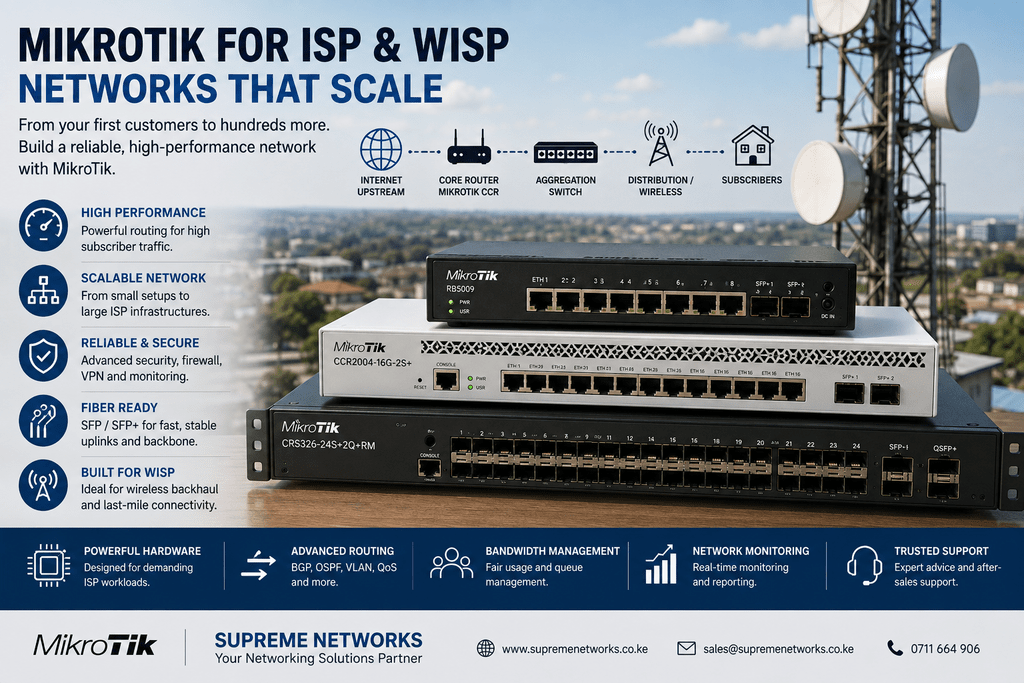
Running an internet service provider is very different from managing a normal office network.
As subscribers increase, the network must handle more traffic, more connections, more routing decisions, and higher expectations for uptime. Equipment that worked during the early stages of the network may eventually become a bottleneck.
This is one reason MikroTik for ISP networks remains an option worth considering. Its portfolio ranges from compact routers to high-capacity Cloud Core Routers and switches designed for demanding networks.
Growth Changes Everything
Imagine starting with 20 customers.
Then you grow to 100.
Eventually, you are serving hundreds of subscribers across different locations.
The challenge is no longer simply providing internet connectivity. You need an infrastructure that can grow alongside the subscriber base.
Your router, switching capacity, fibre uplinks, wireless backhaul, bandwidth management, and network design all become increasingly important.
Start at the Core
The core router plays a critical role in moving traffic between different parts of the network.
For smaller deployments, models such as the MikroTik RB5009 may provide useful routing capabilities.
However, larger ISP environments may require considerably more capacity.
This is where MikroTik’s Cloud Core Router (CCR) family becomes particularly relevant.
Models such as the CCR2004 provide higher-performance routing capabilities for networks where traffic volumes and configuration requirements have moved beyond smaller routers.
Switching Matters Too
Routing is only half of the picture.
ISP and WISP networks may need to aggregate multiple fibre links, wireless connections, servers, routers, and distribution points.
MikroTik’s Cloud Router Switch (CRS) family provides several options for this role.
Depending on the design, models such as the CRS305, CRS309, CRS317, and CRS326 can provide combinations of Gigabit Ethernet and SFP/SFP+ connectivity.
This makes them useful when building fibre aggregation and higher-capacity network links.
Fibre Changes the Network
As bandwidth requirements increase, relying entirely on standard Gigabit copper connections can become limiting.
SFP and SFP+ interfaces allow compatible MikroTik equipment to connect using fibre or suitable direct-attach solutions.
For example:
Access network
↓
Distribution switch
↓
Fibre / SFP+ uplink
↓
Core network
↓
Internet upstream
A properly designed fibre backbone can provide significantly more room for growth.
What About Wireless ISPs?
For WISPs, the network extends beyond the server room.
Wireless links may connect towers, buildings, customer areas, or remote distribution points.
MikroTik offers wireless products designed for different outdoor networking applications. However, wireless performance depends heavily on factors such as distance, frequency planning, interference, antenna selection, line of sight, and installation quality.
The radio is therefore only one part of the design.
RouterOS Gives You the Tools
MikroTik RouterOS provides a wide range of networking capabilities that can be useful in ISP environments.
Depending on the design and hardware, administrators can work with routing, VLANs, firewall policies, VPNs, bandwidth management, network monitoring, and other advanced networking functions.
The important part is not enabling every available feature.
It is building a configuration that remains manageable, secure, and scalable as the network grows.
Don’t Wait for the Bottleneck
Network upgrades are easier when they are planned.
If a router, switch, uplink, or wireless connection is already operating near its practical limits, subscriber growth can quickly expose the weakness.
ISP networks should therefore be designed with reasonable capacity for future expansion.
Your next 100 customers should be part of today’s network planning.
Building or Expanding an ISP/WISP Network?
Supreme Networks supplies MikroTik routing, switching, fibre, and wireless networking equipment for ISPs, WISPs, network installers, businesses, and organizations in Kenya.
From RB5009 and CCR routers to CRS switches, SFP modules, fibre connectivity, and MikroTik wireless equipment, we can help you identify suitable hardware for different parts of your network.
Contact Supreme Networks for MikroTik pricing, availability, and assistance selecting equipment for your ISP or WISP infrastructure.
