
Uncategorized
MikroTik CCTV Network: Build Reliable IP Surveillance
Your CCTV Cameras Are Only as Reliable as the Network Behind Them
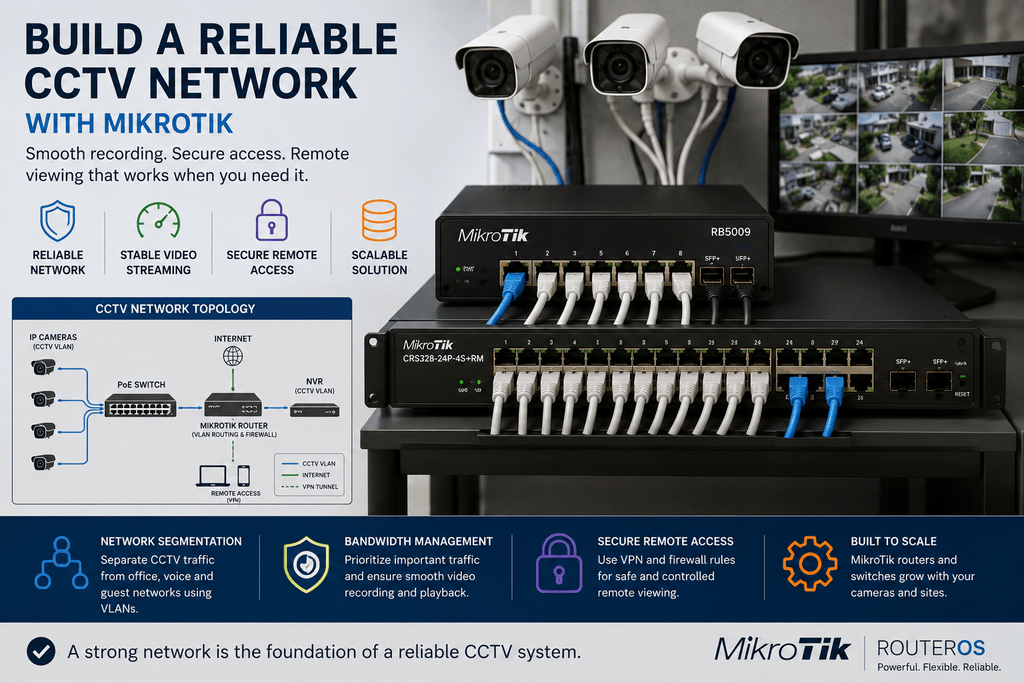
A high-resolution IP camera can capture excellent video. However, if the network carrying that video is poorly designed, users may still experience interruptions, slow remote viewing, or unreliable connections.
That is why a MikroTik CCTV network should be planned around the cameras, recorder, switches, internet connection, and expected traffic.
The network behind the cameras matters just as much as the cameras themselves.
CCTV Creates Continuous Network Traffic
Unlike ordinary office devices, IP cameras can transmit video continuously.
As more cameras are added, the amount of network traffic increases. Higher resolutions, frame rates, and video settings can increase bandwidth requirements further.
Therefore, a network designed for a few computers should not automatically be expected to handle dozens of IP cameras without proper planning.
Keep CCTV Traffic Where It Belongs
One useful approach is separating surveillance equipment from everyday business devices.
With a properly designed network, VLANs can help place IP cameras and related equipment on their own network segment.
For example:
Office VLAN → Computers and printers
CCTV VLAN → IP cameras and NVR
Voice VLAN → IP phones
Guest VLAN → Visitor Wi-Fi
A MikroTik router can then apply routing and firewall policies between these network segments.
This creates a more organized network and allows administrators to control which devices can communicate with each other.
Your NVR Shouldn’t Depend on the Internet
For a local IP surveillance system, camera traffic can normally travel through the local network to the NVR without going out to the internet.
This is important because recording should not depend entirely on the availability of the external internet connection.
Internet connectivity becomes more relevant when authorized users need remote access or when the surveillance solution uses external services.
Don’t Forget the Switch
The router is only one part of a CCTV network.
Your network switches need enough ports and switching capacity for the cameras being connected. If the cameras use Power over Ethernet, the switch must also provide the required PoE standard and sufficient PoE power budget.
For larger installations, uplink capacity also becomes important because traffic from many cameras may eventually pass through the same connection.
Where MikroTik Fits
MikroTik can provide the routing, VLAN, firewall, and network-management foundation around an IP surveillance system.
A smaller installation may only require a modest router. Meanwhile, a larger site with multiple VLANs, remote users, VPN connectivity, several switches, and significant network traffic may benefit from more capable MikroTik hardware.
Models such as the L009, RB5009, and selected CCR routers can serve different network sizes depending on the actual requirements.
Remote CCTV? Think About Security Too
Remote camera viewing is convenient, but access should be designed carefully.
Rather than exposing unnecessary network services, businesses should consider controlled and secure methods of remote connectivity.
MikroTik RouterOS provides firewall and VPN capabilities that can form part of a properly designed remote-access strategy.
The exact configuration should depend on the surveillance platform and security requirements.
Build the Network Before Adding More Cameras
Adding another camera seems simple.
However, as a surveillance system grows from a handful of cameras to dozens across several areas, network design becomes increasingly important.
Plan the bandwidth, VLANs, switches, PoE capacity, uplinks, router performance, power backup, and remote connectivity together.
That creates a stronger foundation for the entire CCTV system.
Building or Upgrading an IP CCTV Network?
Supreme Networks supplies MikroTik networking equipment together with CCTV and network infrastructure solutions for businesses and organizations in Kenya.
Whether you are installing a new IP surveillance system or improving an existing CCTV network, contact Supreme Networks for assistance selecting suitable routers, managed switches, PoE equipment, network cabling, and related infrastructure.
ms.
